Travel Ideas
4 historical sites in Hunedoara County

Hunedoara County is one of those corners of Romania where history is not only preserved but also felt at every step. This region, located in the heart of Transylvania, has witnessed defining moments in Romania’s history, from the times of the Dacians and the Roman conquests, through the legend-filled Middle Ages, all the way to the present day. Here, the past and the present intertwine in a unique way, offering visitors an unforgettable experience.
Hunedoara is home to iconic monuments that reflect the cultural and historical identity of the entire country. Ancient ruins such as Sarmizegetusa Regia, the former capital of the Dacian kingdom, and Ulpia Traiana Augusta, the most important Roman city in Dacia, reveal traces of a long-lost world that was crucial to the formation of the Romanian people. At the same time, the medieval era left behind spectacular constructions such as Corvin Castle, one of the most beautiful Gothic castles in Europe, and Deva Fortress, perched on a dramatic volcanic cone and rich in stories.
What makes Hunedoara truly special is the way history and nature complement each other. Each site is set in an impressive natural landscape: castles perched on steep cliffs, ruins hidden among dense forests, or castles that seem lifted from fairy tales. A visit here is not just a history lesson but also a journey through breathtaking scenery, where the past naturally finds its place in the present.
Whether you are passionate about history, myths, and legends, or simply want to discover the authentic beauty of Transylvania, Hunedoara County awaits you with four unmissable sites, each with its own fascinating story and an important role in Romania’s history.
Corvin Castle – A Gothic Gem in the Heart of Hunedoara
Located in the city of Hunedoara, Corvin Castle, also known as Hunyadi Castle, is one of the most spectacular medieval constructions in Europe and an undeniable symbol of Transylvania. Perched imposingly on a rock above the Zlaști River and surrounded by a picturesque landscape, the castle looks like it has stepped out of a fairy tale, attracting visitors from all over the world.
Construction began in the 15th century under John Hunyadi, one of the great military commanders of the era, who wanted a residence befitting his rank. The castle was built on the foundations of an older fortification and, over the centuries, was expanded and transformed into a harmonious blend of architectural styles – Gothic, Renaissance, and Baroque. Its defining features include massive towers, vaulted halls, an elegant inner courtyard, and a wooden bridge spanning a deep chasm, all reinforcing its image as an impenetrable fortress.
A fascinating aspect of Corvin Castle is the wealth of legends surrounding it. For example, it is said that Vlad the Impaler (the inspiration for the Dracula myth) was imprisoned here for a short period. Another local legend tells of a well in the castle courtyard, dug by three Turkish prisoners who, after 15 years of labor, engraved a message that can still be seen today.

(Source: Zig Zag prin Romania )
Moreover, the castle has witnessed important historical events: from John Hunyadi’s anti-Ottoman battles to the era when the Corvin family dominated the politics of the Hungarian Kingdom. Later, the building served as a noble residence and a symbol of the region’s military and political power.
Today, Corvin Castle is not only an impressive historical monument but also a vibrant place. It hosts medieval festivals, cultural events, and historical reenactments that revive the atmosphere of the past. It frequently appears in lists of the world’s most beautiful castles and remains a major attraction for tourists visiting Romania.
Without a doubt, Corvin Castle is a destination that combines spectacular architecture, captivating legends, and historical significance, making it an unmissable site for anyone visiting Hunedoara County.
Deva Fortress – Hunedoara county's Stone Guardian
Perched on a volcanic hill overlooking the city of Deva, at over 370 meters above sea level, Deva Fortress is one of the most important historical and cultural symbols of Hunedoara County. Its strategic location and the spectacular panorama of the entire Mureș Valley make the fortress impressive, and it has retained its legendary aura, attracting visitors passionate about both history and breathtaking landscapes.

(Source: The Crazy Tourist )
The first documented mentions of the fortress date back to 1269, when it was already a fortified military site of major importance. Built on the ruins of older fortifications, Deva Fortress was reinforced and expanded throughout the Middle Ages to protect the passes and trade routes connecting Transylvania with the Kingdom of Hungary and the rest of Europe.
Over the centuries, Deva Fortress passed through the hands of several rulers: voivodes, Hungarian nobles, Transylvanian princes, and even the Habsburg crown. Each historical period left its mark on the architecture: the massive walls, defensive towers, and later-built bastions reflect the military styles and techniques of the time. In the 17th century, the fortress was transformed into a bastion-style stronghold, playing an important role in the defensive system of the Habsburg Empire.
Unfortunately, in 1849, during the Hungarian Revolution, a munitions depot inside the fortress exploded, causing massive destruction and marking the beginning of its decline. Despite this, the ruins still retain a special beauty, and the surviving walls testify to the crucial role the fortress played in Transylvania’s history.
Today, Deva Fortress is accessible to tourists both on foot and by a modern funicular that climbs the steep hill, offering a spectacular experience. Once at the top, visitors can enjoy a wide view of the Poiana Ruscă Mountains and the Mureș Valley, a panorama that confirms why this fortification was so important over the centuries.
Deva Fortress is not just a historical monument, but also a symbol of resilience and continuity, a place where past and present intertwine to offer visitors an authentic experience.
Sarmizegetusa Regia – The Dacian Capital and Heart of a Forgotten Kingdom
Hidden in the Orăștie Mountains, at an altitude of approximately 1,200 meters, Sarmizegetusa Regia is one of the most fascinating and mysterious sites in Romania. The former capital of the Dacian kingdom, this unique archaeological site preserves the traces of a powerful civilization that, over two millennia ago, managed to stand against Rome’s military might.
Founded in the 1st century BC, Sarmizegetusa Regia was the political, military, and religious center of the Dacians. The city was divided into several distinct areas: the fortress, the civilian settlement, and the sacred zone. The fortress was built from massive limestone blocks joined using the “murus dacicus” technique, characteristic of the Dacians, and still impresses today with its ingenious construction. In the sacred area, archaeological discoveries have revealed impressive temples, including the famous circular calendar, believed to have been used for astronomical observations and religious rituals.

(Source: Basilica )
Sarmizegetusa Regia was not only a spiritual center but also a key military hub. From here, King Decebal led the Daco-Getic resistance against the Romans. After the Daco-Roman wars (101–102 and 105–106 AD), the fortress was conquered and destroyed by the legions of Emperor Trajan, marking the beginning of Dacia’s transformation into a Roman province.
Although destroyed, its legacy endured. The walls and ruins that still stand testify to the greatness of a civilization that left a profound mark on the identity of the Romanian people. It is no coincidence that Sarmizegetusa Regia is included on the UNESCO World Heritage List, recognized as a site of universal significance.
Today, visitors who arrive at Sarmizegetusa Regia walk along the same paths once traveled by priests, warriors, and Dacian leaders. The atmosphere is both mysterious and solemn, and the natural landscape of the Orăștie Mountains adds a special dimension to the experience, making it feel as if time has stood still.
For lovers of history and archaeology, Sarmizegetusa Regia is not just a tourist destination but a true journey back in time, to the roots of the Dacian civilization and the origins of Romania’s history.
Ulpia Traiana Augusta – Rome’s Testimony in the Heart of Dacia
Just a few kilometers from Sarmizegetusa Regia lies another emblematic site of Romania’s ancient history: Ulpia Traiana Augusta Dacica Sarmizegetusa, the capital of the Roman province of Dacia after Trajan’s conquest. Founded at the beginning of the 2nd century AD, this grand city was not only the administrative and political center of the province but also a true demonstration of the Roman Empire’s grandeur.
Built by colonists from across the Empire, Ulpia Traiana Augusta covered an area of over 30 hectares, with strong defensive walls, monumental gates, and paved streets. The city featured elegant forums, temples dedicated to Roman gods, amphitheaters, public baths, and administrative buildings—all reflecting Rome’s urban sophistication and organization. One of the most impressive remains that can still be visited today is the Roman amphitheater, capable of hosting thousands of spectators for performances and gladiatorial games.
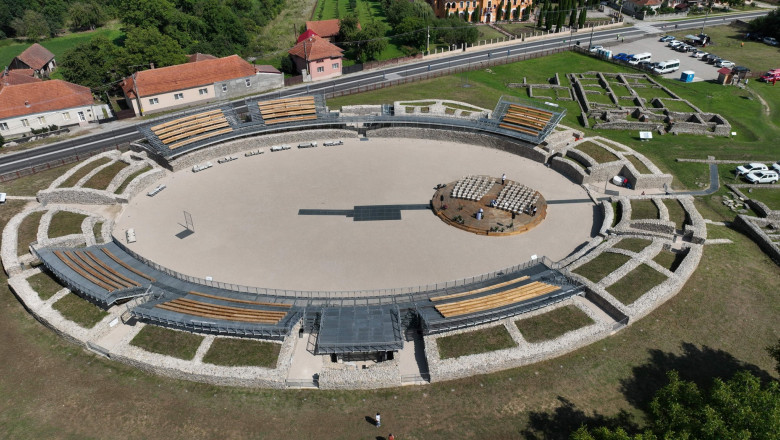
(Source: Digi24 )
The city became the seat of the governor of Dacia, the place from which both the region’s extremely rich mineral resources and the Roman legions were administered. For nearly two centuries, Ulpia Traiana Augusta was the center of the province’s political, economic, and cultural life—a place where local Dacian traditions met and intertwined with Roman culture, giving rise to a new identity.
The city’s decline began in the 3rd century with the withdrawal of the Roman administration from Dacia, but its ruins continued to fascinate generations. Today, the archaeological site is open to visitors, offering an engaging glimpse into daily life in the Roman province.
A walk among the ruins of Ulpia Traiana Augusta is a journey into a world where gladiators competed for glory, priests offered sacrifices to the gods, and governors made decisions that influenced the entire province. It is a living testament to how Rome managed to leave a profound mark on the history and culture of this region.
For lovers of ancient history, Ulpia Traiana Augusta is not just an archaeological site—it is a place where the past comes alive and the legacy of Rome can be felt at every step.
Conclusion – Hunedoara, A Journey Through the Centuries
Hunedoara County is, without a doubt, one of the regions in Romania where history is most vividly felt, and visiting the four sites presented—Corvin Castle, Deva Fortress, Sarmizegetusa Regia, and Ulpia Traiana Augusta—offers a true journey through time, from the Dacian era to the late Middle Ages.
Starting with Corvin Castle, visitors step into the world of knights, the legendary John Hunyadi, and the stories woven over centuries around this Gothic fortress. It is a place where history blends with myth, and its spectacular architecture reflects the power and sophistication of the medieval era.
From Hunedoara, the journey continues to Deva Fortress, perched atop the rocky summit of a volcanic hill. Here, the breathtaking panorama and walls steeped in legend recall the times when the fortress controlled Transylvania’s trade routes and served as a major military stronghold. Even though time and history have brought destruction, the spirit of the fortress continues to watch over the region.
Moving onward, we discover the traces left by the Dacian civilization at Sarmizegetusa Regia, the capital of a kingdom that stood against the mighty Roman Empire. The solemn atmosphere of the ruins, the walls built with the ingenious “murus dacicus” technique, and the sacred sanctuaries transform the visit into a unique, almost mystical experience, bringing the grandeur of the ancestors into the present. This is where Romanian identity finds one of its deepest roots.
In contrast, just a few steps from the Dacian capital lies Ulpia Traiana Augusta, the grand expression of Rome in the heart of conquered Dacia. Forums, temples, amphitheaters, and administrative buildings reveal how the empire imposed its cultural, political, and military influence. Among the ruins, we see how the Dacian world met Roman civilization, giving rise to a cultural synthesis that shaped the history of the region.
Together, these four destinations form a complete story of Hunedoara County: from the strength and spirituality of the Dacians, through Roman brilliance, to the medieval glory of Transylvania. Each site plays its role in the region’s grand historical fresco, offering visitors not only history lessons but also authentic experiences amidst spectacular landscapes.
What makes Hunedoara truly special is precisely this blend of cultures, eras, and architectural styles, transforming a visit into a unique adventure. Whether you are passionate about archaeology, fascinated by medieval legends, or simply love journeys that offer more than just a beautiful view, Hunedoara County has everything you could wish for.
Ultimately, visiting these sites is not just about seeing ruins, walls, or castles—it is about better understanding who we are and where we come from. Hunedoara is a place where history comes alive and where the future of Romanian cultural tourism has a solid foundation. A visit here is not merely a trip, but an experience that stays in your heart, convincing you that Romania’s true wealth lies in its past.