Top7
TOP 7: Things to know about Băile Herculane

The wonderful spa town of Băile Herculane! We've all heard of it, and many of us have probably been there at least once. Because we're talking about a historic and picturesque destination in Romania, with a rich history, famous especially for its therapeutic thermal waters.
Here are seven essential things you need to know about this fascinating destination if you're getting ready for a vacation!
1. Băile Herculane: A Enchanting History
With a history spanning over 2000 years, Băile Herculane has been a favorite spot of emperors and nobles. Legend has it that the god Hercules himself discovered the healing properties of these thermal waters.
"The two-thousand-year history of the resort begins with its first documented mention in the year 153 AD, recorded on a votive tablet discovered in the archaeological sites opened in the mid-19th century in the area of the locality.
Initially known only to the Roman legions stationed in the Severin area and the Roman administration of the region, the resort quickly becomes an important attraction for the aristocracy of ancient Rome. Discovered and cared for by ordinary Romans settled in Dacia, the miraculous thermal springs become objects of veneration throughout the Roman world, with the legendary hero Hercules himself being the protector of the cult dedicated to them," as stated on the official website of the Băile Herculane Town Hall.
You can explore the ancient ruins and discover Roman influences in the city's architecture. A visit to Băile Herculane is a journey through time into the captivating history of Romania.
2. Thermal Springs: An Oasis of Relaxation
One of the biggest attractions of Băile Herculane is its thermal springs. These mineral-rich waters are renowned for their therapeutic properties and attract visitors from all around the world. You can spend relaxing hours in the thermal baths, enjoying the healing effects of the water. It's a truly invigorating and revitalizing experience!
The balneoclimatic resort of Băile Herculane came into existence due to its underground (phreatic and deep) waters.
"The source consists of 19 known natural springs, of which 9 are captured and used. Only a part of the total flow is used based on needs, and the rest overflows freely into the Cerna River," local authorities further inform.
3. Nature Expedition: Domogled-Valea Cernei National Park
Băile Herculane is surrounded by the natural beauty of Domogled-Valea Cernei National Park. Here, you can explore spectacular landscapes, hiking trails, and picturesque waterfalls. Surrounded by wild flora and fauna, you'll have the opportunity to connect with nature in a unique and special way.
Access to Domogled-Valea Cernei National Park is possible through two routes:
DN 6 Bucharest – Timișoara, near the town of Băile Herculane; DN 67 D Băile Herculane – Târgu Jiu, near the town of Godeanu, and the county road Pades – Valea Mare, near the town of Pades-Gorj.
"Domogled Reserve is among the first reserves established in Romania and is endowed with a wide range of fauna and flora, excelling in the diversity of insects," as mentioned in the previously cited source.
4. Architecture and the Atmosphere of the City
Băile Herculane still retains a period atmosphere. Here, you'll find impressive buildings and distinctive architecture. Some of these buildings are undergoing rehabilitation, which is good news as it reflects renewed interest. You can take a stroll through the city center and admire the famous Belle Époque hotels. These iconic structures will transport you back in time and provide a glimpse into the city's fascinating past.
Once you're here, you'll be walking in the footsteps of great historical figures. Throughout history, visitors to the resort have included Emperor Joseph II, Emperor Francis I and Empress Charlotte, Emperor Franz Joseph and Empress Elisabeth.
Furthermore, in 1852, the Emperor of Austria declared Băile Herculane as the "most beautiful resort on the continent."
The natural wonders of the Cerna Valley are featured in the intimate journal of Empress Elisabeth. Here, Băile Herculane holds a captivating and unique presence. The journal is displayed in the Nicolae Cena Museum, whose collections began to form in 1922, as further described on the local authorities' website.
5. A Destination for Adventure Enthusiasts, Not Just Those Seeking Healing
If you're in search of adventure and outdoor activities, Băile Herculane won't disappoint. Here, you can indulge in hiking, climbing, and even cycling. With spectacular landscapes and diverse terrains, you'll have memorable experiences and moments of adrenaline.
But a journey here means more than just physical healing through walks, relaxation, and bathing in the beneficial thermal water—it also provides a form of spiritual healing through tranquility or cultural events that take place. Take, for example, the "International Hercules Festival," which in 2023 marks its 53rd edition from July 3rd to July 7th.
6. Excursions in the Surroundings
Băile Herculane is ideally located for exploring other nearby tourist attractions. There are many fascinating places to explore around Băile Herculane.
You can choose one of the 10 designated routes presented by the authorities:
- Băile Herculane – Hotel ROMAN – Haiducilor Grotto – Steam Grotto – Empress's Pavilion – Yellow Pavilion – Munk Spring – Green Pavilion – Diana Spring ("Empress's Route") – Duration: approx. 3 hours (round trip). Marking: blue dot, red and yellow dot, blue triangle.
- Băile Herculane – Catholic Church – Steam Grotto – Duration: 2 ½ hours (round trip).
- Băile Herculane – Still Water Spring – Domogled – CRUCEA ALBÃ – GROTA LUI ȘERBAN – Duration: approx. 3 hours (round trip). Marking: blue cross and yellow stripe.
- Băile Herculane – Hercules High School – Stadium – Feregari Valley – Prolazului Gorges – Between Stones Cave – Duration: 2 hours (round trip). Marking: red dot.
- Băile Herculane – Pecinișca neighborhood – Gaura Ungurului Cave – Pecinișcă Gorges – Duration: 2 ½ hours (round trip). Marking: yellow stripe.
- Băile Herculane – Diana III Spring – Munk Spring – Cracu lui Arendașu – Coronini Plateau – Duration: 2 ½ hours (round trip). Marking: yellow dot, yellow stripe.
- Băile Herculane – Hercules High School – Prolazului Gorges – Feregari Valley – Colariu Peak – Duration: 3 hours (round trip). Marking: red dot.
- Băile Herculane – "7 Hot Springs" – Ghizelei Cross – Ogașu lui Roșeț – Cociu Waterfall – Duration: 3 hours (round trip). Marking: red dot.
- Băile Herculane – Zăvoi neighborhood – Coronini Plateau – Green Pavilion – Munk Spring – Yellow Pavilion – Steam Grotto – Haiducilor Grotto – Duration: 3 hours (round trip). Marking: blue dot, red and yellow dot, blue triangle.
- Băile Herculane – Bridge over Cerna at km 10 – Vânturîtoarea Waterfall – Duration: 2 hours (round trip). Marking: red cross.
These routes offer diverse opportunities to explore the natural beauty and historical attractions surrounding Băile Herculane.
7. Local Cuisine and Delicious Wines
Your visit to Băile Herculane wouldn't be complete without tasting the local traditional cuisine. Try authentic Romanian dishes in local restaurants and savor the excellent wines produced in the region. The local cuisine and wines are an essential part of the culinary experience in Băile Herculane.


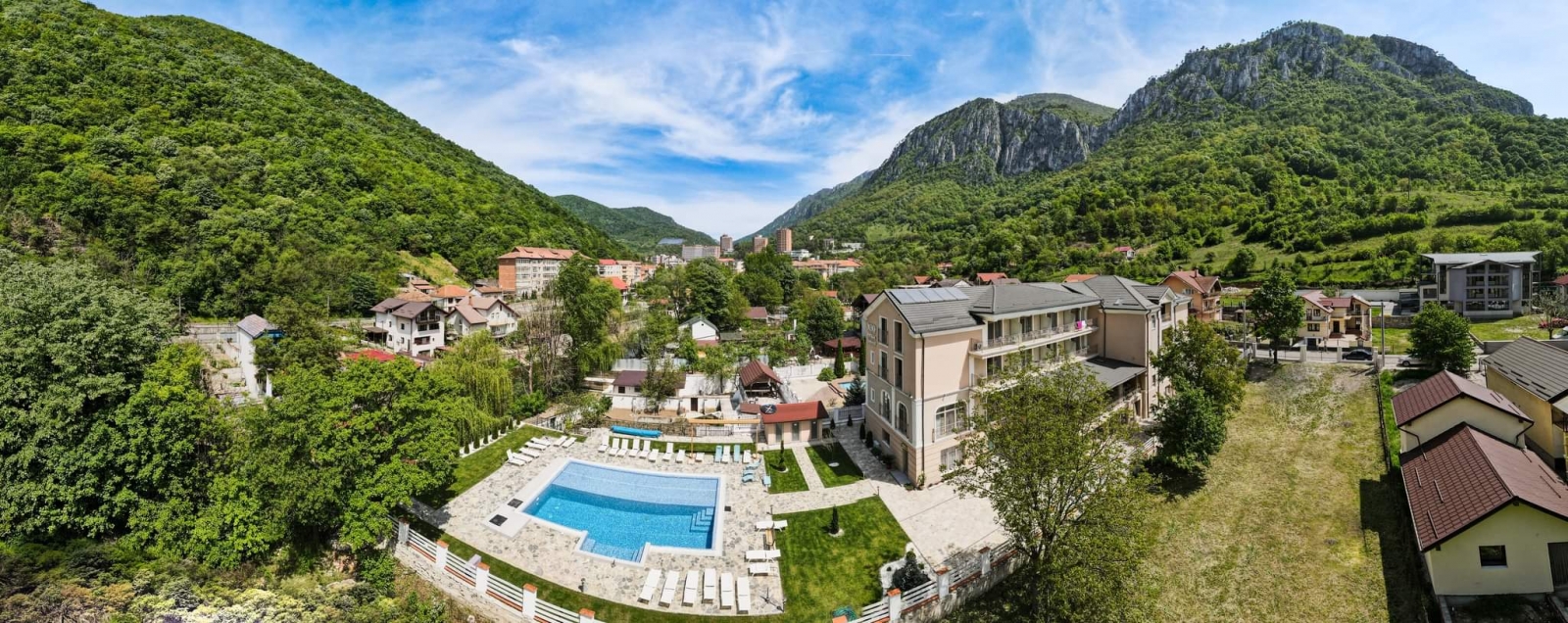

So, Băile Herculane awaits you with a unique combination of history, relaxation, adventure, and natural beauty. Don't miss the opportunity to explore this wonderful corner of Romania and enjoy everything it has to offer. A journey to Băile Herculane will undoubtedly be a memorable experience, leaving you with unforgettable memories!
Foto: Facebook/Baile Herculane – Cazare si Turism