Travel Ideas
The Mystical Silence of the Cave Monastery in Șinca Veche and the Pure Adrenaline of the Bear Observatory
A successful trip doesn't always have to mean exhausting mountain trails. If you are looking for peace, fresh air, and a relaxing atmosphere far away from the urban hustle, we invite you to discover a unique destination in Brașov County, ideal for your next weekend getaway. Tucked away between the Făgăraș and Perșani Mountains, just 45 kilometers from Brașov, lies a small village that shelters one of the country's most enigmatic secrets: the Șinca Veche Cave Monastery, a fascinating place of worship carved directly into the heart of a cave beneath Pleșu Hill. And if, after the mystical silence inside the grotto, you feel the need for a dose of adrenaline, a true wilderness experience awaits you nearby: the bear observatory in Șinca Nouă.
About the Șinca Veche Cave Monastery
Known to the public as the "Temple of the Chosen", the Cave Monastery in Șinca is a mystical sanctuary carved into stone, whose exact age has not been established with certainty to this day. The underground monastery owes its tumultuous past to its location on the historical border between historical Romania and the Habsburg Empire.
Most experts believe that the complex gained its current form in 1742, a time when practicing the Orthodox religion was banned in Transylvania. However, there are documents that mention this place as far back as the 12th century. The legends surrounding the cave are absolutely fascinating: some bold theories place the origin of these rock-cut rooms in the Dacian period. Other speculations go even further back in time, attributing a staggering age of about 7,000 years to the structure and linking it to the same mysterious prehistoric culture that is said to have built the White Temple on Snake Island.
A unique feature of the site is that it has two altars, leaving many to wonder if it was originally designed as a classic Christian place of worship. Most likely, there were initially two parallel altars separated by a massive rock wall. Over time, this natural barrier collapsed, revealing a single monumental chamber. The question marks are further fueled by the fact that not a single representation of the cross can be found in any of these rooms.
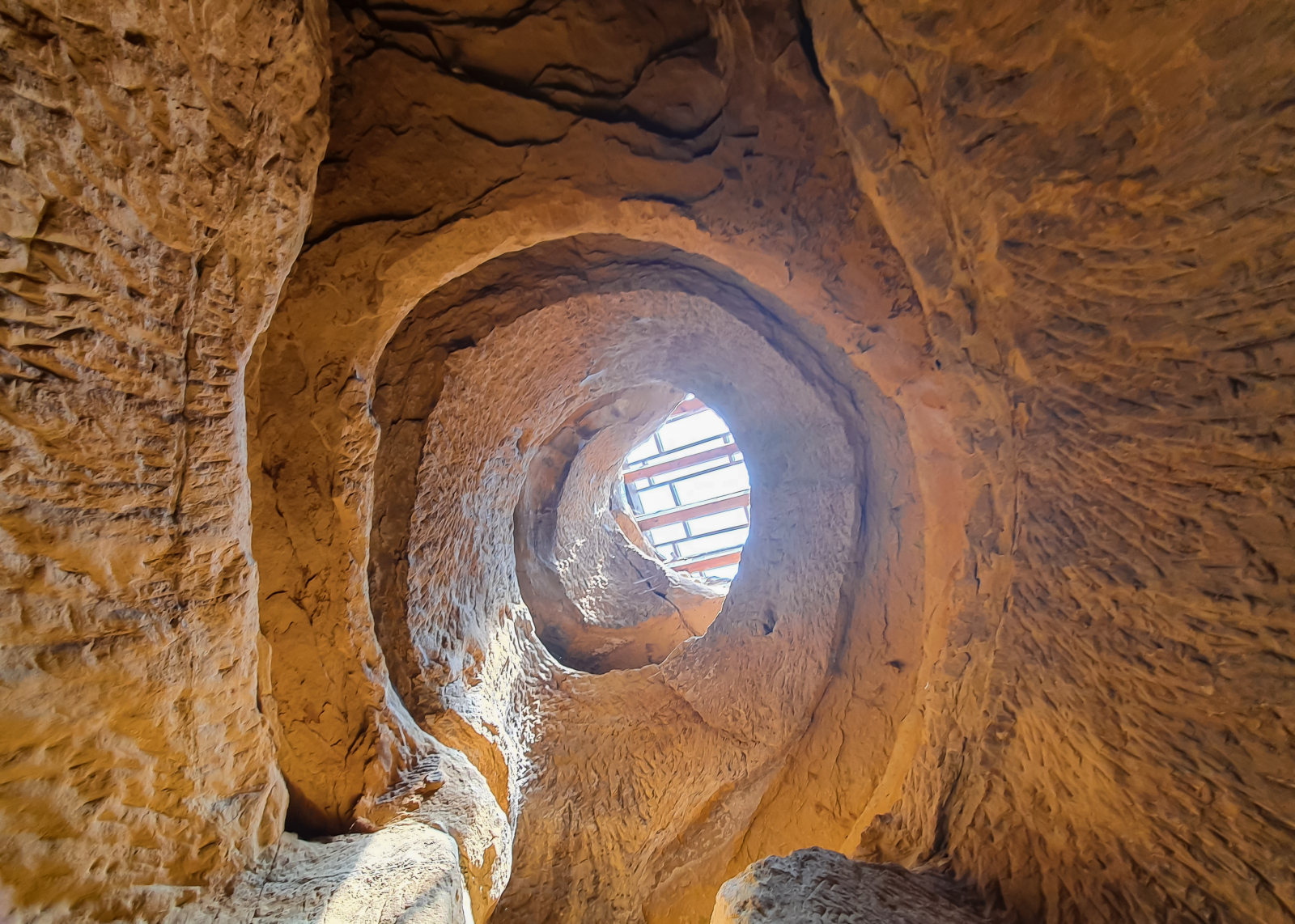
Above the altar closer to the entrance opens an impressive, 10-meter-high, spiral-shaped shaft that leads directly to the open sky, letting natural light penetrate into the depths. In the second altar, your gaze is drawn to a Star of David deeply scrawled into the rock. Yet, just like many other symbols lining the cave walls, the mystery remains complete: specialists cannot date it accurately, nor can they provide a definitive historical interpretation.

(Source: Mănăstire Şinca Veche)
Archaeological excavations played an essential role in saving the monastery. During the official digs in 1994 and 2005, specialists completely cleared the area of debris from collapses, successfully mapping the structure of the rock-cut complex with high precision.
Beyond the legends, studies reveal a stunning architectural reality: the grotto houses two distinct churches built in continuation of each other. They are joined by a spectacular, 13-meter-long narthex (pronaos), and sunlight is ingeniously captured underground through a horn-shaped tower. Although experts could not establish the exact date of its founding, evidence found during the excavations showed unequivocally that the sanctuary was the site of an active Orthodox monastic life in the 17th and 18th centuries. Since the excavations and conservation work, the cave monastery has been under official historical monument protection, meaning that water infiltration and the danger of the fragile rock collapsing no longer pose a threat to visitors.

(Source: Mănăstire Şinca Veche)
Adrenaline in the Forest
After the mystical silence and spiritual calm of the cave monastery, a dynamic experience in the middle of nature provides the perfect contrast. Don't miss a visit to the nearby bear observatory located in Șinca Nouă for a memorable encounter with wildlife. Unlike a classic zoo visit where animals are kept captive, this place offers a lesson in freedom. With no cages or artificial barriers, the bears emerge naturally from the thick forest straight into the clearing, in their native environment. This spectacle of wild nature can be watched in all its splendor from a secure wooden cabin, located just a stone's throw away.
The location itself is in the wonderful and untouched Strâmba Valley, in the heart of a fairytale secular forest that has even been nominated for UNESCO World Heritage status. In this protected reserve, the hand of man does not interfere with nature at all, so you will drive to the starting point among giant beech and fir trees, hundreds of years old and nearly 50 meters tall. Few know it, but this valley is home to the tallest fir tree in Romania (62.5 meters) and the tallest beech tree in all of Europe (55.1 meters).
Tours to the observatory usually start in the second half of the afternoon, the time when wild animals head out actively searching for food. Complete silence must be maintained inside the cabin, but in exchange for your patience—with a bit of luck—you can see several bears at once: mother bears with playful cubs or even huge, tusked males. Furthermore, thanks to the amazing biodiversity of the Șinca Nouă forest, it is common for wild boars, roe deer, or stags to appear alongside the bears at the edge of the clearing. The luckiest visitors might even spot a lynx, a wolf, or rare species like the black stork and the golden eagle flying above the trees.
The observatory windows are made of a special one-way mirror glass, meaning the animals cannot see inside and do not feel the presence of humans at all. Because of this, they will behave completely naturally in front of you, and you can take brilliant photographs without disrupting their daily routine.
For everything to go perfectly, you must keep in mind a few strict forest rules: you must come to the observatory dressed in dark-colored clothes (preferably green, brown, or black) and wearing sturdy hiking boots. It is also a good idea to bring warm clothes with you, as the temperature drops quickly in the forest. You can bring water or coffee, but it is strictly forbidden to bring any food or snacks into the observatory area, so that the smells do not distract the animals. Additionally, camera flashes and phone sounds must be turned off completely. An important practical detail is that, for safety and discipline reasons, only children over the age of 9 can participate in this program.
Although the presence of bears cannot be 100% guaranteed, since it is a completely wild environment, the chances for a memorable encounter are very high. The two destinations create a memorable contrast: the monastery hidden in the rock offers a moment of peace and self-discovery, while the foray into the wilderness connects you with the living rhythm of the forest. To explore the region without rushing, especially if you are traveling a longer distance, you can plan your entire stay by booking accommodation directly on stayhere.ro.

(Source: Observator de ursi)